


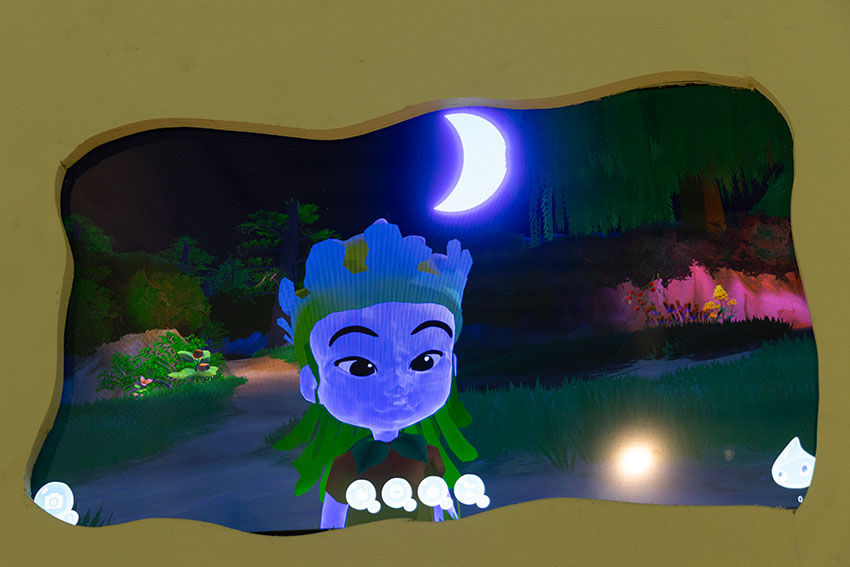
How Does it End? is a story terrain that invites you into the changing rhythms of places, time, allusions, senses, songs and stories. Moving through roots, luminance and memory, it wishes to take a visitor into the folds of uncertainty and the never-ending nature of stories that we inhabit, inherit and invent.
Spatially, the exhibit is an interplay of materials – appropriated perennial shrub Aripoo (Lantana Camara), programmed LED strips, and repurposed shipping ropes, creating an intimate space for our collective voices to be held and be heard. The exhibit invites one to sit and slowly sip the allure of what we have always shared in the warmth and safety of trees and fires – the memories that root us, the hopes that move us and the spaces that linger in their meeting.
Questioning futures of our pasts, and accepting that nothing in nature concludes neatly, How Does it End? makes space for ecologies that loop, regenerate, pause and return.
Foregrounding the politics of the locality, the work extends to a public program that listens to and partakes in stories told by Kerala-based storytellers – from puppetmakers and indigenous musical archivists to shadow puppeteers, food artists, filmmakers, and more.
What do roots know that branches forget?
I.
Mind Spirals
Lorem ipsum dolor sit amet, consetetur sadipscing elitr, sed diam nonumy eirmod tempor invidunt ut labore et dolore magna aliquyam erat, sed diam voluptua. At vero eos et accusam et justo duo dolores et ea rebum. Stet clita kasd gubergren, no sea takimata sanctus est.
Lorem ipsum dolor sit amet, consetetur sadipscing elitr, sed diam nonumy eirmod tempor invidunt ut labore et dolore magna aliquyam erat, sed diam voluptua. At vero eos et accusam et justo duo dolores et ea rebum. Stet clita kasd gubergren, no sea takimata sanctus est Lorem ipsum dolor sit amet.




I.
Aripoo/Indigenous Creativity
Lantana Camara, or Aripoo as it’s colloquially called in Kerala, is a perennial shrub native to the tropics of South America. It was first introduced in South Asia by the British Colonial administration as an ornamental plant. In a little over 200 years, it has disrupted native ecosystems, reduced biodiversity, and is now considered a critical agricultural and ecological challenge across the region.
And yet, this colonially invasive species, when encountered with indigenous knowledges and crafts, turns a curse into a blessing. Lantana Crafts is an organisation that works with indigenous communities in the forests of western ghats in Karnataka and Tamil Nadu.


II.
Thee/Convivial Technology
The warmth and instinct of gathering, imagining and meaning-making have travelled with us through millennia. In stories, songs, dance and mixing of voices, we have found communities, continuity, safety and each other. Huddling around a fire has been one of the most ancient instruments of bringing us together. We affirm this primordial practice and extend it as a literal site of coming together.
The fireside incorporates 4200 LEDs upon 60 odd towers creating an audiovisual illusion of a digital campfire. ‘Motherflame’ is an invitation to dreamwalk between technology, nature and art.


III.
Kadha/Telling Tales
Contrasted with Aripoo (Lantana Camara) an invasive plant, Aal Maram/ Banyan trees (Ficus Benghalensis) is a native perennial to South Asia, their deep integration into the regions’ ecology, culture and mythology has venerated them to the status of ‘wisdom tree’ and in many cases a village gathering space.
In How Does It End? you sit below this iconic tree, recreated with repurposed fishing/shipping ropes. A place to pause and re-emerge, the tree lends its shadow for you to ask questions that have simmered under your skin, or walked with you for days long and short. Here, read what others have returned to in their quiet hours, listen to the faint murmurs that have kept some awake through the nights, toy and turn over the curiosities many amongst us wonder about, and when you find the moment, pick a pen and add one of yours.


A SAVVYZΛΛR live radio broadcast from Forplay Society, Kochi to Berlin by
Ola Zielińska, Seljuk Rustum, Articultural Society, Zalman Farizy, S. S. Santosh Kumar, Yenting Hsu among others
By Padmashri Ramachandra Pulavar and team from Krishnan Kutty Pulavar Memorial Tholpavakoothu Puppet Center, Shornur, Palakkad
Followed by an open dialogue in the framework of “Negotiating Shadows: Artist, Agency, and Labour in Tholpavakoothu” with faculty members from Bharata Mata College, Thrikkakara and Tholpavakoothu Artists
Collaborative Making and Listening Practices - A sensory, listening-led gathering moving through field recordings, live sound and conversations, shaped by Murthovic’s long-term collaborative practice with Indigenous communities as co-creators, grounded in the idea of sound as a living, shared cultural practice.
Murthovic & Gopika (Nadabramha Studio) 8.30 pm - 9.30 pm
A participatory workshop performance exploring human and non-human inhabitants of Kochi through puppets and storytelling by Rashida M, Sandhya A, Anjana A S

From Field to Forum is a multi-format public programme by ARPO that brings together archival material, field recordings, films, and live performances to explore culture as a living, evolving process—not a static record.
At its core, the programme reflects on how oral memory and music travel from intimate community spaces into public forums, and what is gained, transformed, or at times unsettled in that journey.
Conversation / Walk-through
An informal, guided discussion led by ARPO with artists and researchers, examining questions of cultural archiving: Who records culture? How is it represented? For whom is it preserved—and at what cost? The walk-through offers insights into ARPO’s archival practices, as well as the ethical choices, learnings, and un-learnings that shape our work with sensitive communities.Live Performances
Indigenous and traditional musicians—fellows from the Earthlore programme—perform songs rooted in their lived cultures and landscapes. These performances are presented not as revival or display, but as contemporary expressions of continuity, memory, and presence.Together, the programme opens a space to reflect on care, responsibility, and collaboration in cultural work—where documentation, performance, and dialogue meet.
Gatherings

GATHERINGS
11 & 18.01.26
Sonic Postcards From Kochi
A SAVVYZΛΛR live radio broadcast from Forplay Society, Kochi to Berlin by Ola Zielińska, Seljuk Rustum, Articultural Society, Zalman Farizy, S. S. Santosh Kumar, Yenting Hsu among others


20.01.26
Tholpavakoothu : Ritual Shadow Puppetry & Panel Discussion
By Padmashri Ramachandra Pulavar and team from Krishnan Kutty Pulavar Memorial Tholpavakoothu Puppet Center, Shornur, Palakkad. Followed by an open dialogue in the framework of “Negotiating Shadows: Artist, Agency, and Labour in Tholpavakoothu” with faculty members from Bharata Mata College, Thrikkakara and Tholpavakoothu Artists.


20.01.26
Our Lands Sing On: A Multi-Sensory Gathering
Collaborative Making and Listening Practices - A sensory, listening-led gathering moving through field recordings, live sound and conversations, shaped by Murthovic’s long-term collaborative practice with Indigenous communities as co-creators, grounded in the idea of sound as a living, shared cultural practice. Murthovic & Gopika (Nadabramha Studio) 8:30 pm - 9:30 pm


6–8.02.26
Between Goats & Ghosts
A participatory workshop performance exploring human and non-human inhabitants of Kochi through puppets and storytelling by Rashida M, Sandhya A, Anjana A S


29.03.26
From Field to Forum: Oral Memory, Music, and Contemporary Presence
From Field to Forum is a multi-format public programme by ARPO that brings together archival material, field recordings, films, and live performances to explore culture as a living, evolving process—not a static record. At its core, the programme reflects on how oral memory and music travel from intimate community spaces into public forums, and what is gained, transformed, or at times unsettled in that journey. Together, the programme opens a space to reflect on care, responsibility, and collaboration in cultural work—where documentation, performance, and dialogue meet.


December 2025 & 01.02.2026 – 31.03.2026
Kitchen Alchemy
Kitchen Alchemy is an immersive multi-sensory installation that reimagines domestic kitchens as an artistic narrative space. This live installation focuses on the domestic kitchen as not just a site of food preparation but as a dynamic locus of memory, creativity, and intergenerational knowledge sharing through stories. Central to this work are the voice recordings of a child dispersed throughout the space, reaffirming the child as not a passive recipient of cultural knowledge but as an active narrator whose voice shapes the shared culinary archive.


January 2026
Puppet Workshop with Mamo and Malu
Over four days children of Gujarathi Vidyalaya High School, Mattancherry co created stories and puppets, performing with confidence and joy. Supported by Forplay Society and SAVVY Contemporary.


January 2026
Earthlore, Unplugged
For the concluding session of our Perennial Resonances series, we gathered with our collaborators ‘ARPO - Archival and Research Project’ to explore how folklores are archived and lived today. We had the gracious presence of Majeesh Karayadu, someone who collected over 1000 folk pieces, had the chance to view kaatunayakka community come alive on screen and the Earthlore Fellows blessed us with their stories and songs.


A SAVVYZΛΛR live radio broadcast from Forplay Society, Kochi to Berlin by
Ola Zielińska, Seljuk Rustum, Articultural Society, Zalman Farizy, S. S. Santosh Kumar, Yenting Hsu among othersBy Padmashri Ramachandra Pulavar and team from Krishnan Kutty Pulavar Memorial Tholpavakoothu Puppet Center, Shornur, Palakkad
Followed by an open dialogue in the framework of “Negotiating Shadows: Artist, Agency, and Labour in Tholpavakoothu” with faculty members from Bharata Mata College, Thrikkakara and Tholpavakoothu ArtistsCollaborative Making and Listening Practices - A sensory, listening-led gathering moving through field recordings, live sound and conversations, shaped by Murthovic’s long-term collaborative practice with Indigenous communities as co-creators, grounded in the idea of sound as a living, shared cultural practice.
Murthovic & Gopika (Nadabramha Studio) 8.30 pm - 9.30 pm
A participatory workshop performance exploring human and non-human inhabitants of Kochi through puppets and storytelling by Rashida M, Sandhya A, Anjana A S
From Field to Forum is a multi-format public programme by ARPO that brings together archival material, field recordings, films, and live performances to explore culture as a living, evolving process—not a static record.
At its core, the programme reflects on how oral memory and music travel from intimate community spaces into public forums, and what is gained, transformed, or at times unsettled in that journey.
Conversation / Walk-through
An informal, guided discussion led by ARPO with artists and researchers, examining questions of cultural archiving: Who records culture? How is it represented? For whom is it preserved—and at what cost? The walk-through offers insights into ARPO’s archival practices, as well as the ethical choices, learnings, and un-learnings that shape our work with sensitive communities.Live Performances
Indigenous and traditional musicians—fellows from the Earthlore programme—perform songs rooted in their lived cultures and landscapes. These performances are presented not as revival or display, but as contemporary expressions of continuity, memory, and presence.Together, the programme opens a space to reflect on care, responsibility, and collaboration in cultural work—where documentation, performance, and dialogue meet.
Gatherings
Creators
‘How Does It End?’ is not created by a single author or beat. Meet here the artists, craftspeople, storytellers, technologists, organisers, and communities across regions and practices, who brought their own histories, hands, and ways of knowing into the work.
(In alphabetical order)




Arshootti

Abhishek Nilambar
Articultural Society

Sulfath

Clarence P A

Cleetus P M


Clarence P A

Cleetus P M


Eva Vonk
Jayraj Patil

Aaromal G Aash
Deepak K J
Josey N M

Kshitij Mittal

Joshey

Madesha C

Madeva
Lost Kids
Garage

Nainy Sahani

Murthovic

Naga

Sajeer K J

Noufal Ibrahim

Narayanan
Shankara M
Sandra C S
Sannappa

Shiva
Aaromal G
Aash
Deepak K J
Jayraj Patil

Josey N M

Eva Vonk

Joshey
Lost Kids
Garage
Madeva

Kshitij Mittal

Madesha C

Naga

Nainy Sahani
Murthovic

Narayanan

Sajeer K J
Sandra C S

Noufal Ibrahim

Sannappa

Shiva
Shankara M

Arshootti
Sulfath
Abhishek
Nilambar

Articultural Society
Lost Kids
Garage
Madesha C
process
Forplay Society, Fort Kochi, India | Nov – Dec 2025
Lorem ipsum dolor sit amet, consetetur sadipscing elitr, sed diam nonumy eirmod tempor invidunt ut labore et dolore magna aliquyam erat, sed diam voluptua. At vero eos et accusam et justo duo dolores et ea rebum. Stet clita kasd gubergren.
process


